Util Increase Cost
Type: Goal
Encourage objects to land on under-utilized scope items by penalizing utilization above a lower bound. A scope item below the lower bound can take on more load for free, while pushing a scope item past the lower bound incurs a cost---so objects are drawn toward the emptiest scope items. When several scope items are below the lower bound, the choice between them is arbitrary.
Parameters
| Parameter | Type | Required | Default | Description |
|---|---|---|---|---|
name | string | Yes | - | Descriptive name for logging/debugging |
scope | string | Yes | - | Scope whose scope items are penalized (e.g. "host") |
dimension | string | Yes | - | Dimension whose relative utilization is penalized |
lowerBound | double | Yes | - | Relative-utilization threshold; only utilization above it is penalized |
squares | bool | No | false | Raise the penalty to a superlinear power (1.1, despite the name), penalizing higher utilization disproportionately |
filter | Filter | No | all scope items | Which scope items count toward the goal |
Example
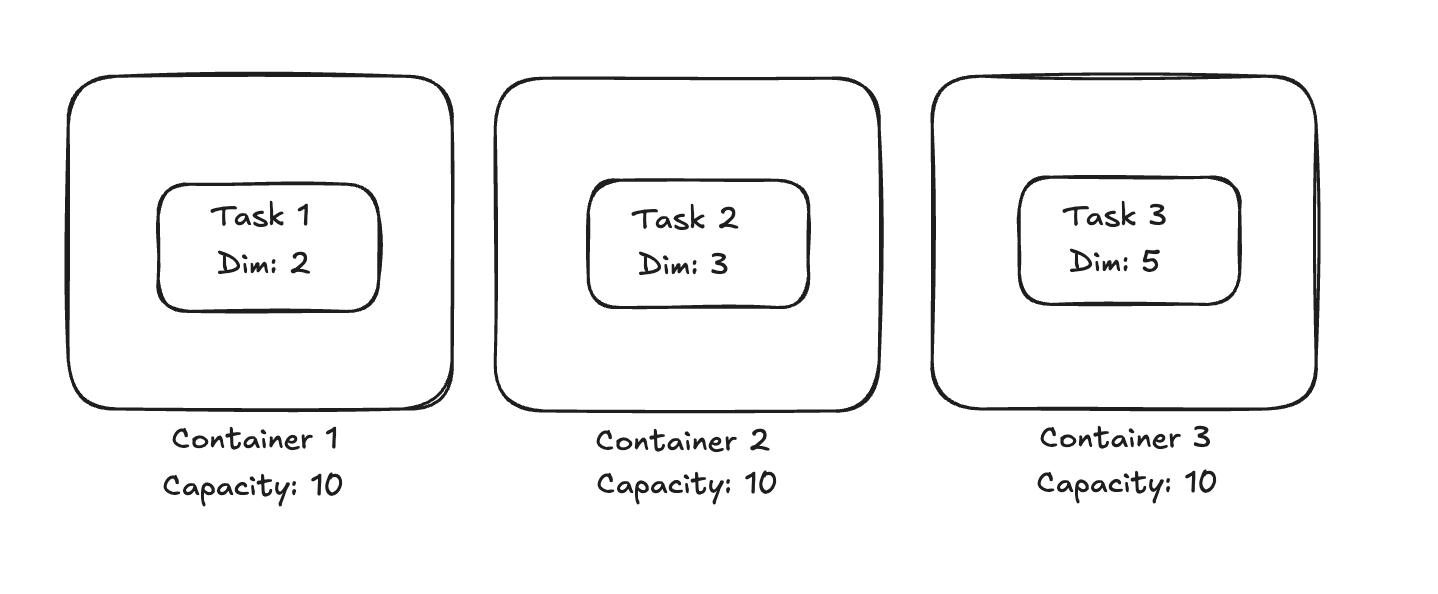
An example use: drain a host while filling the emptiest hosts first. Three hosts have
a capacity of 10 and a lower bound of 0.5. host0 is at 0.2, host1 at 0.3, and
host2 at 0.5 (exactly the bound). We drain host0; its task should land on host1
(which has room below the bound) rather than host2 (already at the bound, so any
addition is penalized).
(source)
(The diagram labels these from 1: Container 1 = host0, Task 1 = task0, and so
on.)
Initial assignment:
solver.setObjectName("task");
solver.setContainerName("host");

solver.setAssignment(std::map<std::string, std::vector<std::string>>{
    {"host0", {"task0"}},  // util 0.2
    {"host1", {"task1"}},  // util 0.3
    {"host2", {"task2"}},  // util 0.5 == lower bound
});

// cpu load per task; each host has a capacity of 10.
solver.addObjectDimension(
    "cpu", std::map<std::string, double>{{"task0", 2}, {"task1", 3}, {"task2", 5}});
solver.addContainerDimension(
    "cpu", std::map<std::string, double>{{"host0", 10}, {"host1", 10}, {"host2", 10}});

// Drain host0.
ToFreeSpec toFree;
toFree.containers() = {"host0"};
solver.addConstraint(toFree);

// Penalize utilization above the 0.5 lower bound.
UtilIncreaseCostSpec utilIncreaseCost;
utilIncreaseCost.scope() = "host";
utilIncreaseCost.dimension() = "cpu";
utilIncreaseCost.lowerBound() = 0.5;
utilIncreaseCost.squares() = true;
solver.addGoal(utilIncreaseCost);
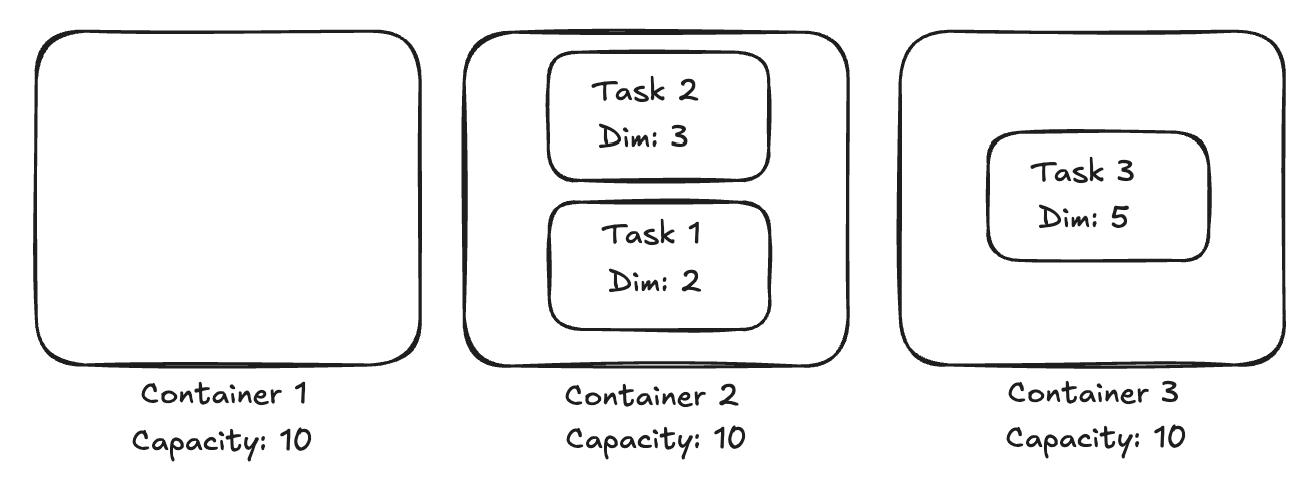
task0 moves to host1, bringing it to exactly the lower bound (0.5) at no cost.
Moving it to host2 instead would push that host above the bound and incur a
penalty.
Final assignment:
Goal only
UtilIncreaseCost can only be used as a goal; there is no constraint form. Its penalty competes with other goals, so it nudges placement toward under-utilized scope items rather than enforcing a hard rule.
Larger-capacity bias with squares
When every candidate scope item is already above the lower bound, the squares
formula biases placement toward larger-capacity scope items, which is often not
what you want. The reason: relative utilization is absoluteUtil / capacity, so
adding an object raises a bigger scope item's relative utilization by less than it
raises a smaller one's. The squared penalty therefore grows more slowly on the larger
scope item, making it look cheaper---so load piles onto the biggest scope items. If
you need balanced relative utilization instead, use Balance with its
IDEAL formula, which compares scope items by relative
utilization directly and does not over-load the larger ones.
More Examples
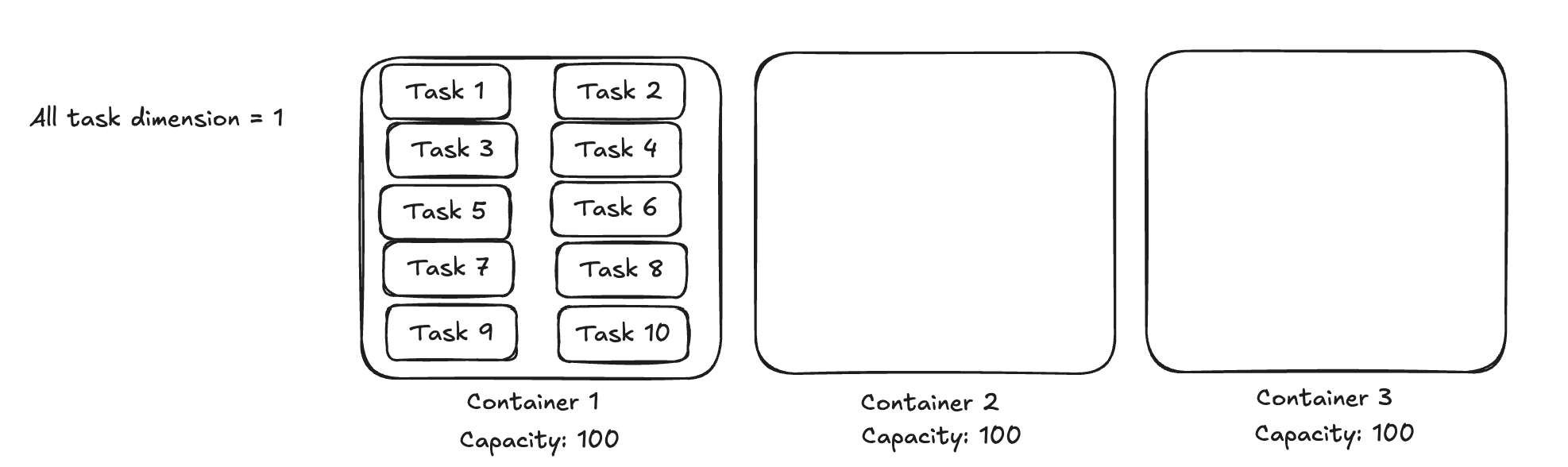
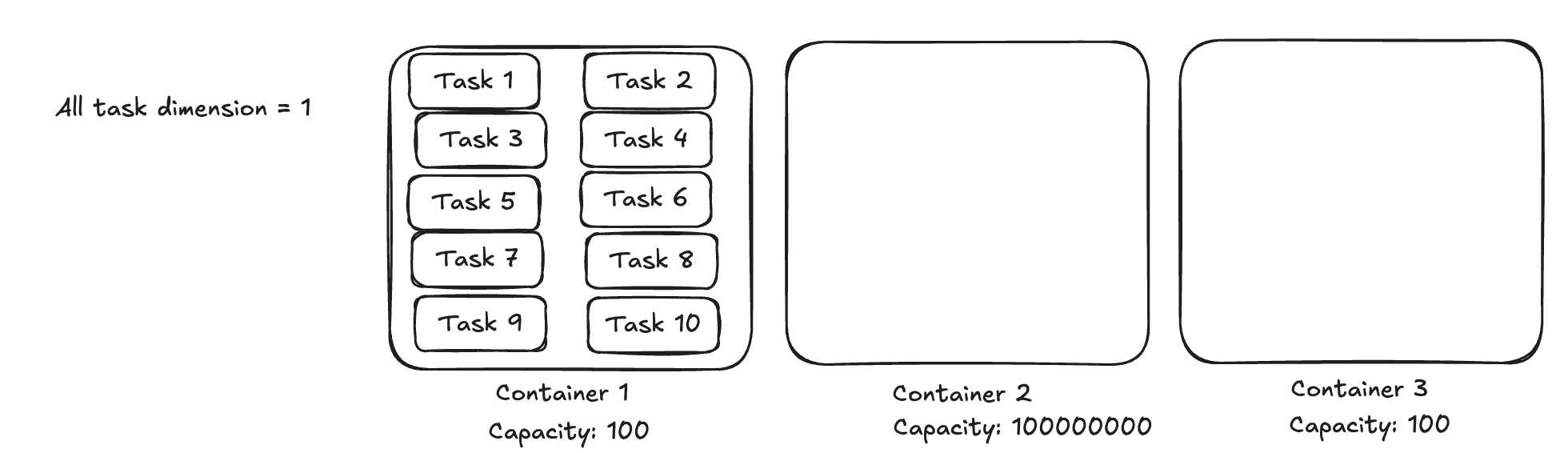
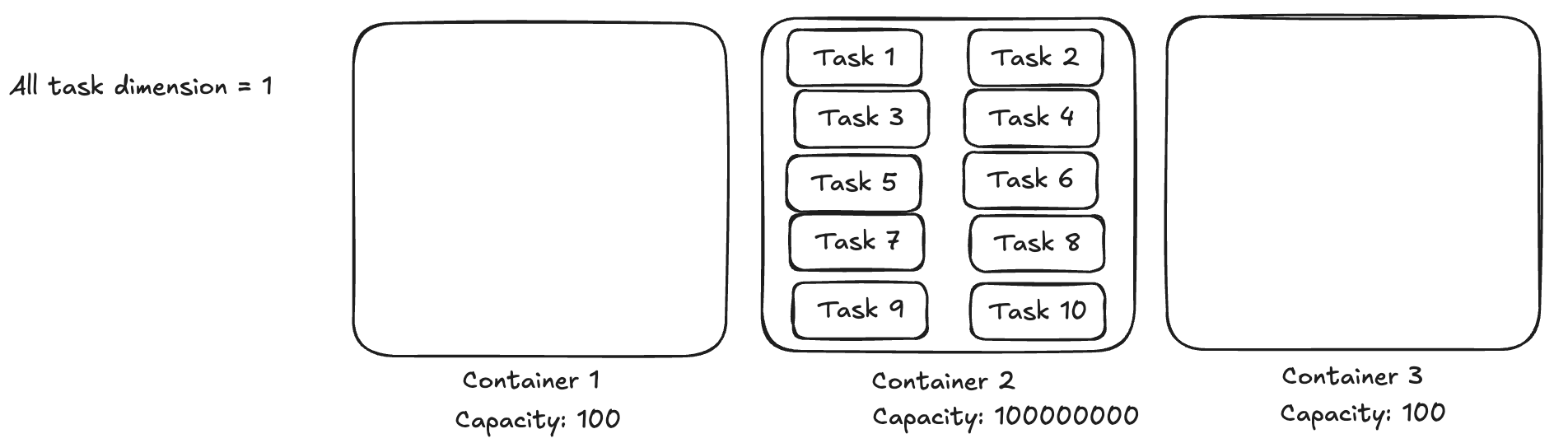
Both examples drain host0, which starts with 10 tasks (each cpu = 1) while
host1 and host2 start empty.
Example 2: multiple scope items below the lower bound
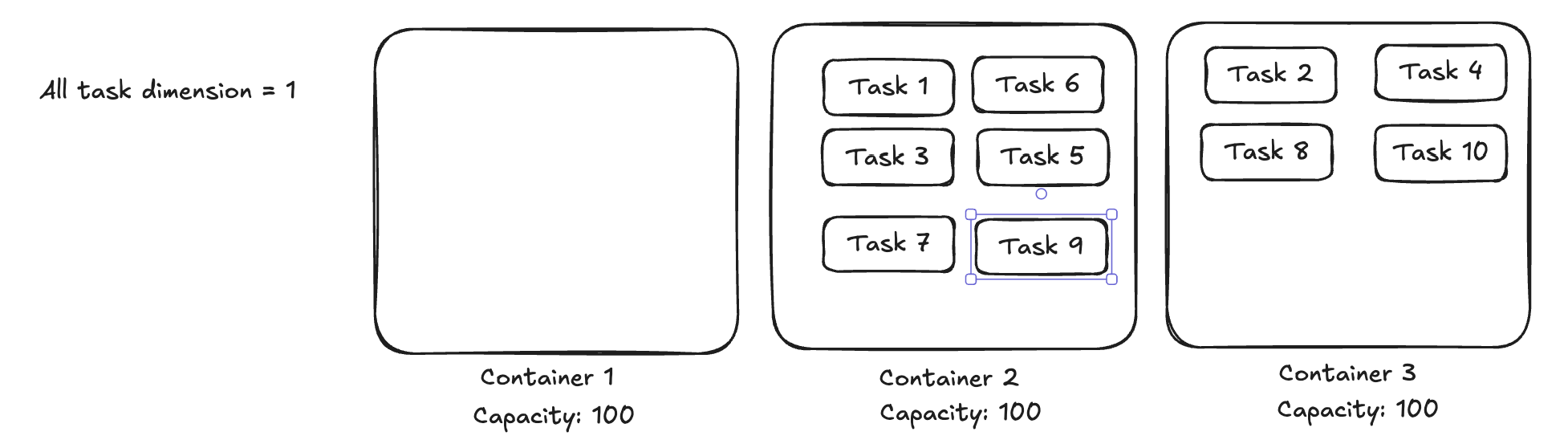
With a lower bound of 0.5 and a capacity of 100 per host, both host1 and host2
stay below the bound no matter how the 10 tasks are split, so there is no penalty to
distinguish them---the tasks are placed across the two arbitrarily.
(source)
Initial assignment:
Final assignment:
Example 3: all scope items above the lower bound (larger-capacity bias)
With a lower bound of 0, every host is above the bound as soon as it holds a task.
host1 has a far larger capacity than host2, so under the squares formula it
absorbs the smaller relative-utilization increase, and all 10 tasks move there---an
illustration of the larger-capacity bias.
(source)
Initial assignment:
Final assignment:
Source
- Thrift definition:
interface/thrift/ProblemSpecs.thrift(UtilIncreaseCostSpec) - SpecBuilder:
materializer/spec_builder/UtilIncreaseCostSpecBuilder.cpp---the code that defines this spec's behavior - Tests and runnable examples:
interface/tests/UtilIncreaseCostTest.cpp---the unit tests the snippets on this page are drawn from