Minimize Containers
Type: Goal
Pack objects onto as few scope items as possible. Despite the name, the spec
minimizes the number of scope items that are in use within a scope (which is
the container scope by default, but can be any scope). A scope item counts as in use
when its utilization for dimension is greater than zero.
Parameters
| Parameter | Type | Required | Default | Description |
|---|---|---|---|---|
name | string | Yes | - | Descriptive name for logging/debugging |
scope | string | Yes | - | Scope whose in-use scope items are minimized (e.g. "host", "rack") |
dimension | string | Yes | - | Dimension that marks a scope item as in use (commonly the object-count dimension); a scope item is in use when its sum is > 0 |
containerCosts | map<string, double> | No | 1.0 each | Per-scope-item cost. Emptying a higher-cost scope item is preferred; on a tie in load, the higher-cost scope item is freed first |
maxFreeLimit | i32 | No | all scope items | Stop once this many scope items have been emptied (see How packing stops) |
filter | Filter | No | all scope items | Which scope items are considered |
formula | MinimizeContainerSpecFormula | No | NEW | NEW supports maxFreeLimit, local search, and containers outside the scope; LEGACY is being deprecated |
Example
An example use: pack tasks onto fewer hosts. Two hosts each hold two tasks; the goal consolidates them onto a single host (the other ends up empty). Since every task has the same load, the tasks may end up on either host.
solver.setObjectName("task");
solver.setContainerName("host");

solver.setAssignment(std::map<std::string, std::vector<std::string>>{
    {"host0", {"task0", "task1"}},
    {"host1", {"task2", "task3"}},
});

// Pack tasks onto as few hosts as possible.
MinimizeContainersSpec minimizeContainers;
minimizeContainers.scope() = "host";
minimizeContainers.dimension() = "task_count";
solver.addGoal(minimizeContainers);
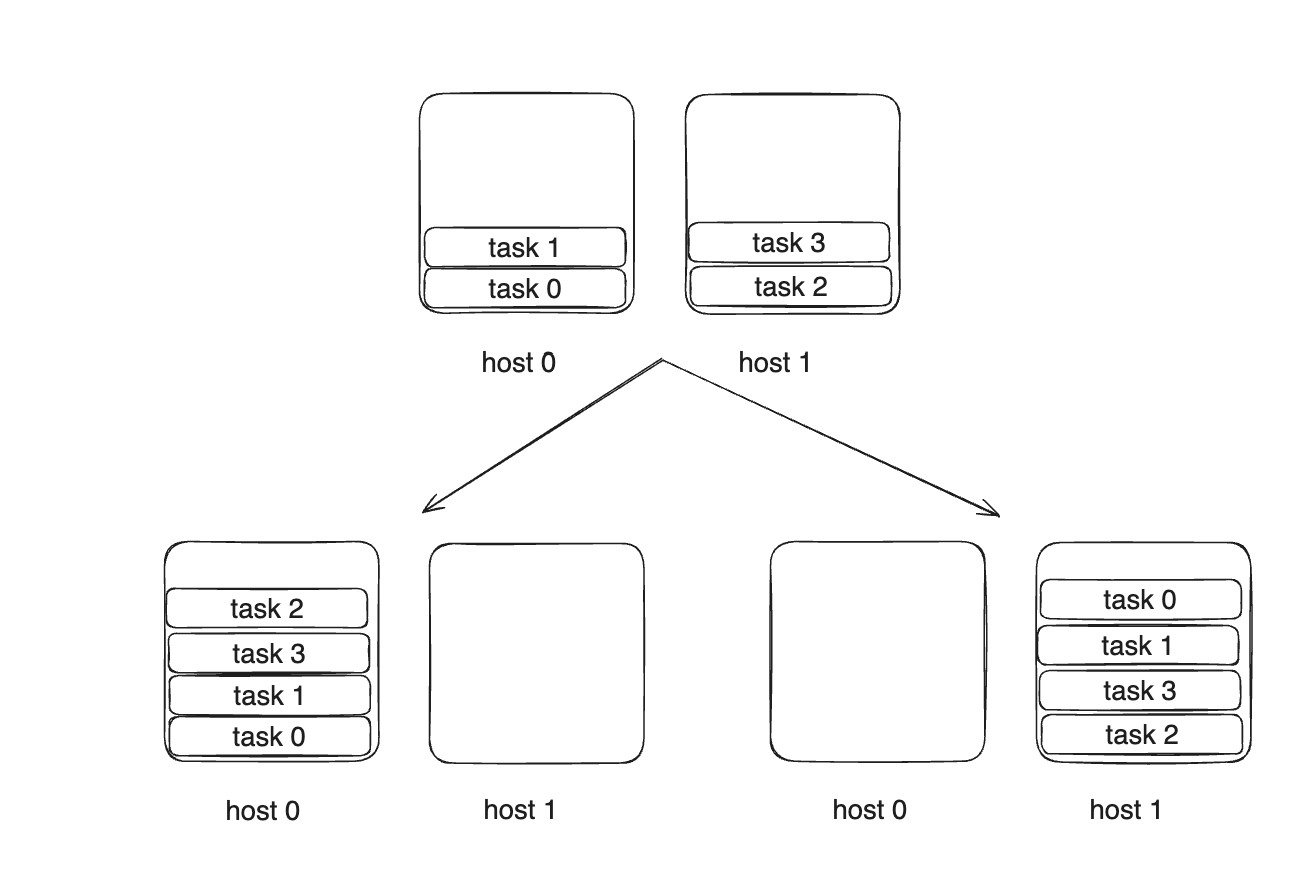
(source)
Goal only
MinimizeContainers can only be used as a goal; there is no constraint form. Its cost competes with other goals, so a scope item is emptied only when the packing gain outweighs any movement or affinity costs.
How packing stops
Packing continues until either all objects in the scope are in a single scope item,
or the number of emptied scope items reaches maxFreeLimit (whichever comes first).
The default maxFreeLimit is the total number of scope items, so by default the goal
packs as tightly as possible. containerCosts breaks ties: among equally-loaded
scope items, the one with the higher cost is freed first.
Despite its name, the spec minimizes in-use scope items of scope. When scope
is a higher-level grouping (e.g. rack), it frees scope items of that grouping and
may even move objects to containers outside the scope to do so (see
Example 4).
MinimizeContainers does not support dynamic object dimensions or negative dimension values.
More Examples
Example 2: with a capacity constraint
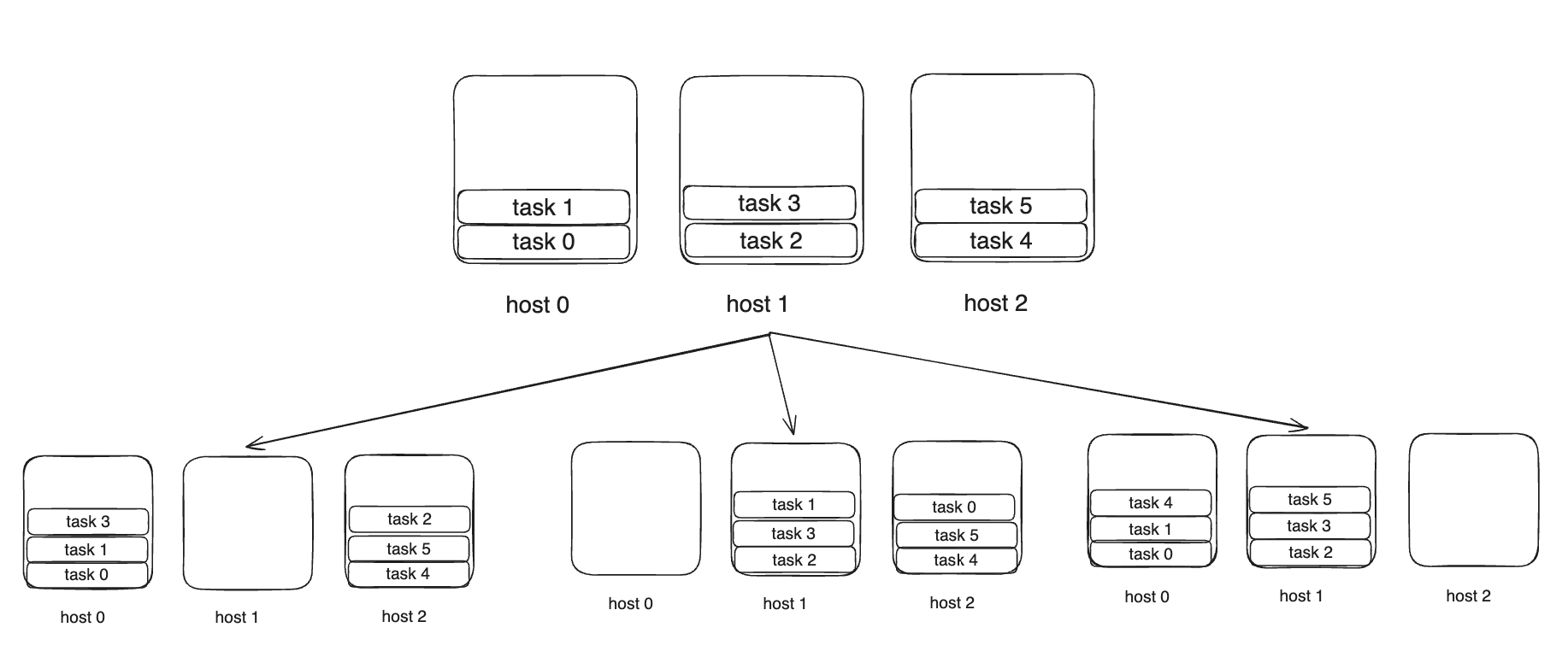
Three hosts each hold two tasks, with a Capacity constraint of 3 tasks per host. Only one host can be emptied (the other two must each hold 3 tasks to stay within capacity), so two hosts remain in use. (source)
Example 3: with maxFreeLimit and costs
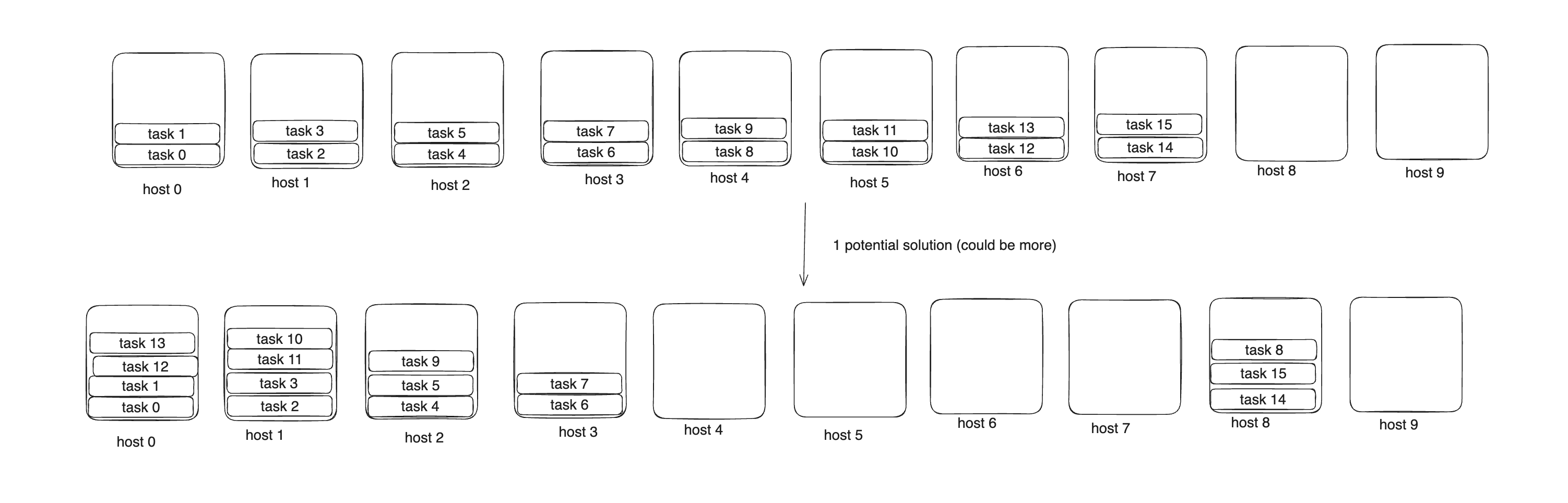
Ten hosts: host0-host7 hold increasing numbers of tasks while host8 and
host9 start empty, with ascending per-host costs (and the two empty hosts cheap).
With maxFreeLimit of 5, Rebalancer frees five scope items in total---the two
already-empty hosts plus three more---preferring to empty the highest-cost occupied
hosts and consolidating their tasks onto cheaper ones.
(source)
Example 4: scope items above the container level
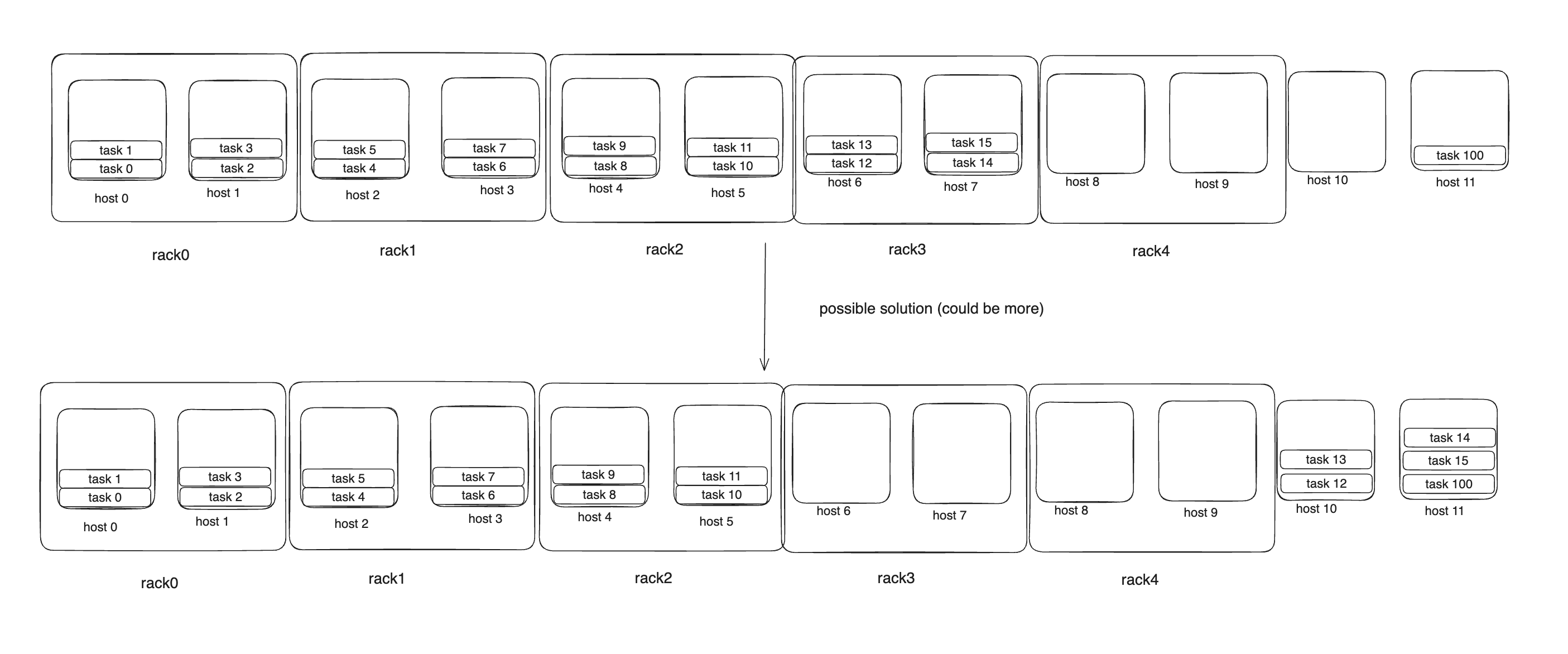
Here the scope is rack rather than host. With maxFreeLimit of 2, the goal
frees two racks. Because it minimizes scope items (racks), it may move objects onto
hosts that are not in any rack to empty a rack.
(source)
Source
- Thrift definition:
interface/thrift/ProblemSpecs.thrift(MinimizeContainersSpec) - SpecBuilder:
materializer/spec_builder/MinimizeContainersSpecBuilder.cpp---the code that defines this spec's behavior - Tests and runnable examples:
interface/tests/MinimizeContainersTest.cpp---the unit tests the snippets on this page are drawn from