Colocate Groups
Type: Goal or Constraint
Keep the objects of the same group together in the same scope item. For example, place all tasks of a job on the same host, or spread a group across no more than a handful of racks.
Parameters
| Parameter | Type | Required | Default | Description |
|---|---|---|---|---|
name | string | Yes | - | Descriptive name for logging/debugging |
scope | string | Yes | - | Scope whose scope items a group is colocated within (e.g. "host", "rack") |
partitionName | string | Yes | - | Partition whose groups are colocated (e.g. "job") |
limits | Limit | No | ABSOLUTE, globalLimit 1 | Max number of scope items a group may spread across (see Limit) |
bound | ColocateGroupsSpecBound | No | MAX | Whether limits is an upper (MAX) or lower (MIN) bound on the spread |
scopeItemWeights | map<string, double> | No | 1 per scope item | Per-scope-item weight toward the limit (see Scope item weights) |
dimension | string | No | object count | What a group's presence in a scope item is measured by; defaults to object count |
squares | bool | No | false | As a goal, square each group's excess before summing |
filter | Filter | No | all scope items | Which scope items count toward the limit (see Filter) |
Example
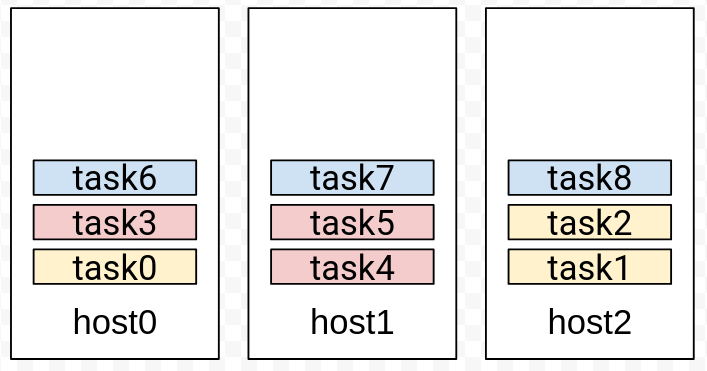
An example use: force every job's tasks onto a single host. There are 9 tasks and
3 hosts, with tasks split evenly into 3 jobs (job0 = task0-task2, job1 =
task3-task5, job2 = task6-task8). The initial placement scatters each job
across all three hosts.
Initial assignment:
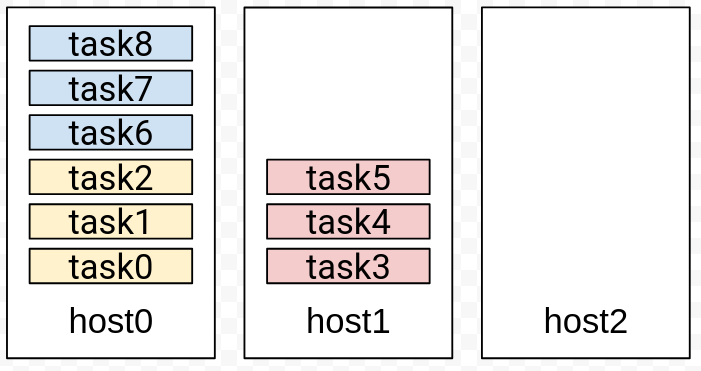
A ColocateGroups constraint with the default limit of 1 forces each job onto one
host. The final placement is not unique, but every job is fully contained in a
single host (here host2 ends up empty).
solver.setObjectName("task");
solver.setContainerName("host");

solver.setAssignment(std::map<std::string, std::vector<std::string>>{
    {"host0", {"task0", "task3", "task6"}},
    {"host1", {"task4", "task5", "task7"}},
    {"host2", {"task1", "task2", "task8"}},
});

// Tasks are evenly split into 3 jobs.
solver.addPartition(
    "job",
    std::map<std::string, std::string>{
        {"task0", "job0"}, {"task1", "job0"}, {"task2", "job0"},
        {"task3", "job1"}, {"task4", "job1"}, {"task5", "job1"},
        {"task6", "job2"}, {"task7", "job2"}, {"task8", "job2"}});

// Each job's tasks must land on a single host (default limit of 1).
ColocateGroupsSpec colocateGroups;
colocateGroups.scope() = "host";
colocateGroups.partitionName() = "job";
solver.addConstraint(colocateGroups);
Final assignment:
ColocateGroups is most often a hard constraint, which usually needs the optimal (MIP) solver. See more examples below for non-default limits, scope-item weights, and combining it with other specs.
Goal vs. constraint
As a constraint, the limit is enforced: each group spreads across at most
limits scope items (or at least, with a MIN bound). If the initial assignment
already satisfies it, the final one will too; if it is initially broken, the
general constraint policy applies.
As a goal, the spec's value is the aggregated violation amount---the sum, over all groups, of how much each group exceeds its colocation limit.
Limit
The limits (Limit) sets the maximum number of scope
items a group may spread across; the default is 1 (every group confined to a
single scope item). Raising it lets a group occupy more scope items---for example,
a limit of 2 permits a group to span two hosts even when another goal would
otherwise pull it wider apart (Example 2). As with other specs, the
Limit fields let you vary the bound per group or per scope item.
Scope item weights
By default, each scope item a group occupies contributes 1 toward the limit.
scopeItemWeights overrides that per scope item: a weight of 0 makes occupying
that scope item free (it never counts toward the limit), 2 makes it count
double, and so on. This expresses that spreading into some scope items is "more
expensive" than others (Example 3).
Filter
The filter (Filter) restricts which scope items the
colocation limit applies to: set itemsWhitelist (only these count) or
itemsBlacklist (all but these). Scope items excluded by the filter do not count
toward a group's limit.
More Examples
All examples below build on the same kind of setup as the example above---tasks partitioned into jobs across a few hosts. Each links to its runnable unit test.
Example 2: non-default limit
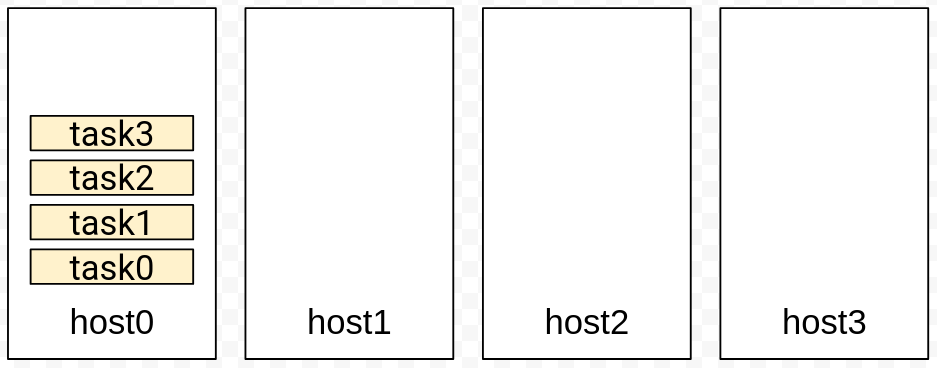
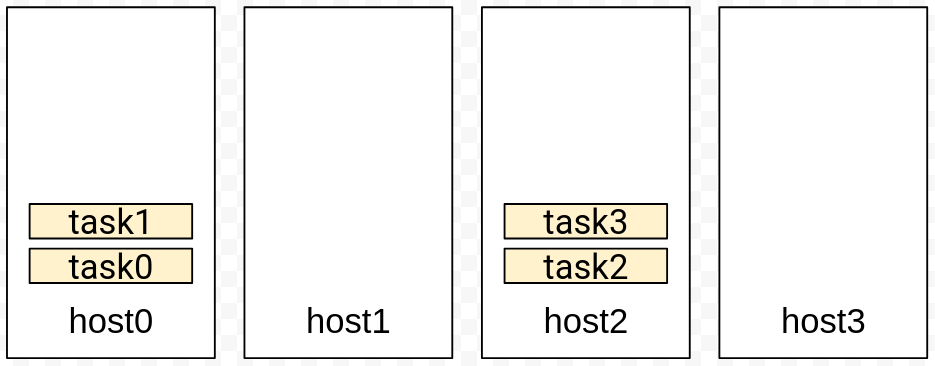
A ColocateGroups constraint with a limit of 2, alongside a goal to balance tasks
across hosts. The limit caps each job at two hosts even though the balance goal
would otherwise spread it wider.
(source)
Initial assignment:
Final assignment:
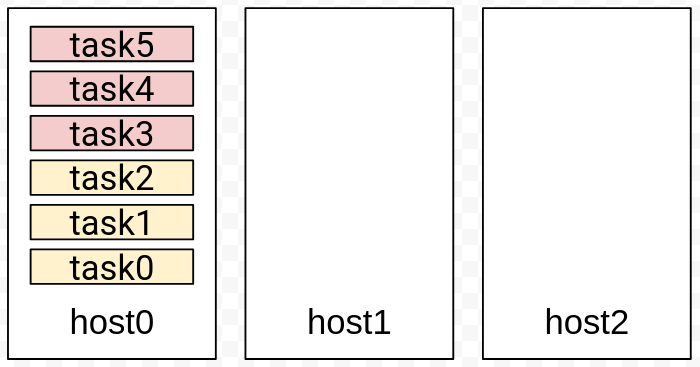
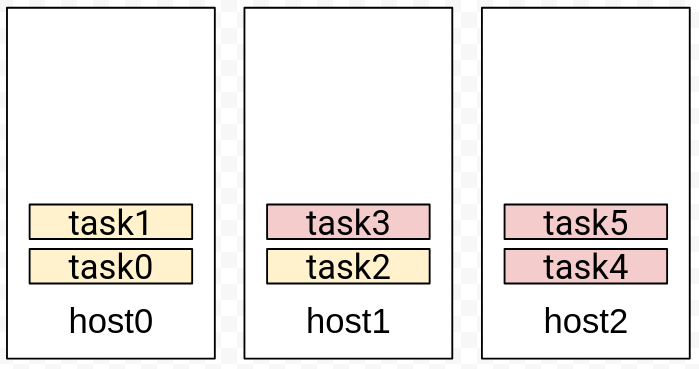
Example 3: scope item weights
A ColocateGroups constraint with a limit of 3 and weight overrides of 2 for
host0 and host2, plus a balance goal and an AssignmentAffinities goal making
task0 prefer host0. Each group ends up exactly at its colocation cost of 3
(e.g. job0 pays 2 for host0 plus 1 for host1).
(source)
Initial assignment:
Final assignment:
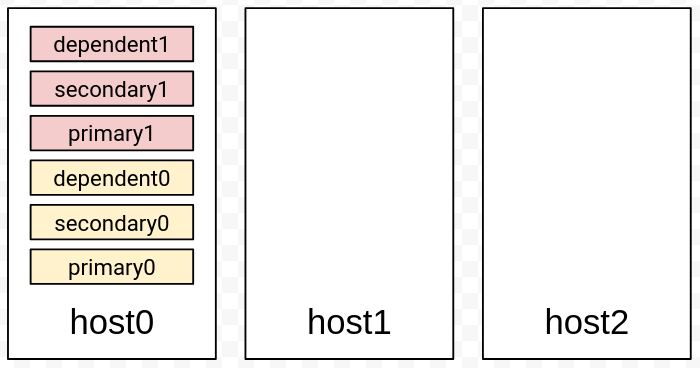
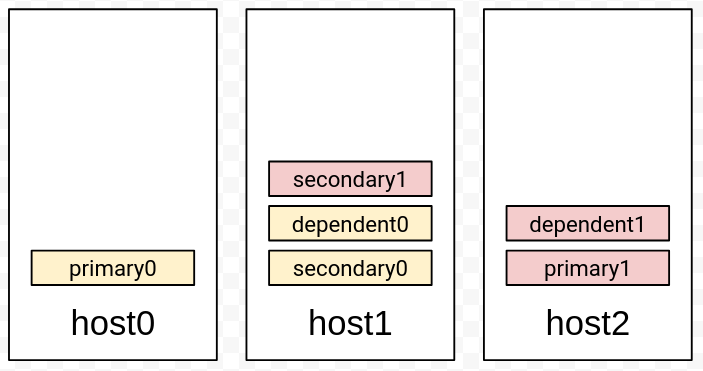
Example 4: primary, secondary, and dependent triplets
Triplets (primary{i}, secondary{i}, dependent{i}) where the primary and
secondary must be on different hosts (a GroupCount constraint of 1
per ID group), while the dependent must share a host with one of them (a
ColocateGroups constraint limiting each triplet to at most 2 hosts).
(source)
Initial assignment:
Final assignment:
Source
- Thrift definition:
interface/thrift/ProblemSpecs.thrift(ColocateGroupsSpec) - SpecBuilder:
materializer/spec_builder/ColocateGroupsSpecBuilder.cpp---the code that defines this spec's behavior - Tests and runnable examples:
interface/tests/ColocateGroupsTest.cpp---the unit tests the snippets on this page are drawn from