Non Accepting
Type: Constraint
Prevent a given set of scope items from receiving any new objects. For example, stop a host that is being drained from accepting more tasks while a rebalance runs.
Parameters
| Parameter | Type | Required | Default | Description |
|---|---|---|---|---|
name | string | Yes | - | Descriptive name for logging/debugging |
scope | string | Yes | - | Scope the listed scope items belong to (e.g. "host", "rack") |
items | list<string> | Yes | - | The scope items that may not receive any new objects |
A listed scope item may keep the objects already assigned to it, but no object that is not already there may move in.
Example
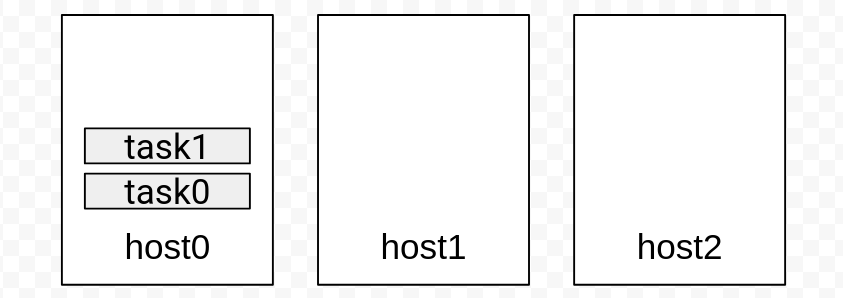
An example use: pin a host so nothing new lands on it. There are 3 hosts and 2
tasks, both initially on host0. A NonAccepting constraint marks host1 as
non-accepting. An AssignmentAffinities goal then expresses that task0 prefers
host1 and task1 prefers host2.
(source)
Initial assignment:
solver.setObjectName("task");
solver.setContainerName("host");

solver.setAssignment(std::map<std::string, std::vector<std::string>>{
    {"host0", {"task0", "task1"}},
    {"host1", {}},
    {"host2", {}},
});

// host1 may not accept any new objects.
NonAcceptingSpec nonAccepting;
nonAccepting.scope() = "host";
nonAccepting.items() = {"host1"};
solver.addConstraint(nonAccepting);

// task0 prefers host1, task1 prefers host2.
auto pref = [](std::string task, std::string host, double affinity) {
  AssignmentAffinity entry;
  entry.objectName() = std::move(task);
  entry.scopeItemName() = std::move(host);
  entry.affinity() = affinity;
  return entry;
};

AssignmentAffinitiesSpec affinities;
affinities.scope() = "host";
affinities.affinities() = {
    pref("task0", "host1", 1),
    pref("task1", "host2", 1),
};
solver.addGoal(affinities);
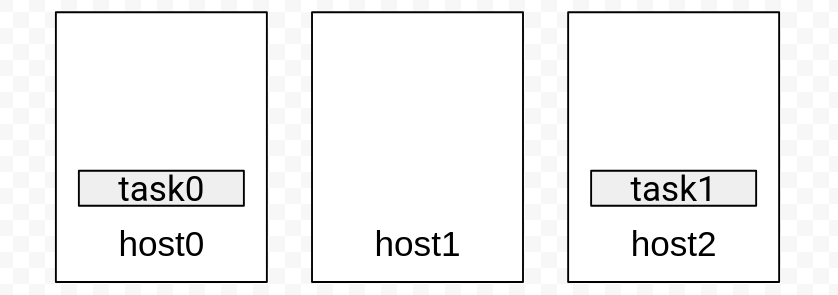
task1 moves to host2, which it prefers. task0 would prefer host1, but it
cannot move there because that would violate the NonAccepting constraint, so it
stays on host0.
Final assignment:
Constraint only
NonAccepting can only be used as a constraint; there is no goal form. It only forbids new placements into the listed scope items, so it always holds in the initial assignment and, under the default constraint policy, Rebalancer is guaranteed to not move an object into a listed scope item.
Source
- Thrift definition:
interface/thrift/ProblemSpecs.thrift(NonAcceptingSpec) - SpecBuilder:
materializer/spec_builder/NonAcceptingSpecBuilder.cpp---the code that defines this spec's behavior - Tests and runnable examples:
interface/tests/NonAcceptingTest.cpp---the unit test the snippet on this page is drawn from