Group Move Limit
Type: Constraint
Limit how many objects of the same group are allowed to move. For example, cap how many tasks of a job may be reassigned in a single rebalance, so a job is never disrupted too much at once.
GroupMoveLimit currently supports only the container scope, so every scope item referred to below is a container.
Parameters
| Parameter | Type | Required | Default | Description |
|---|---|---|---|---|
name | string | Yes | - | Descriptive name for logging/debugging |
partitionName | string | Yes | - | Partition whose groups' moves are limited (e.g. "group") |
limit | Limit | No | ABSOLUTE, globalLimit 1 | Max number of moves allowed per group (see Limit) |
sourceScopeItemsAffectingLimitFilter | Filter | No | all scope items | Only moves out of these scope items count toward a group's limit (see Which moves count) |
destinationScopeItemsAffectingLimitFilter | Filter | No | all scope items | Only moves into these scope items count toward a group's limit (see Which moves count) |
dimension | string | No | object count | What a move's size is measured by; defaults to the number of objects moved |
Example
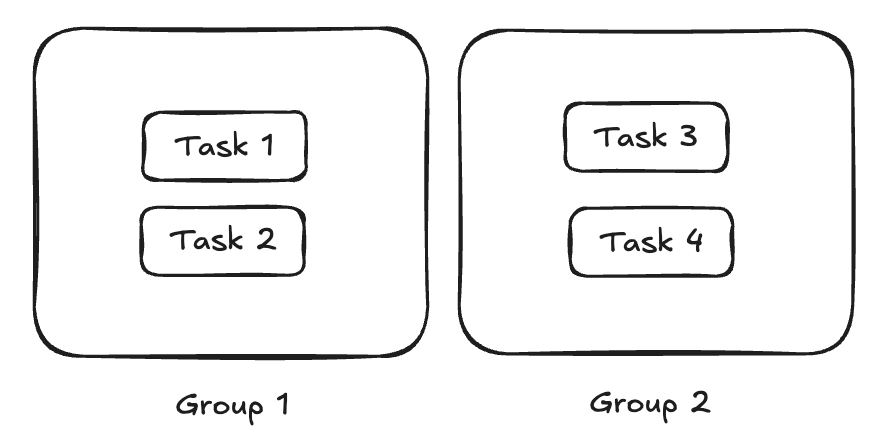
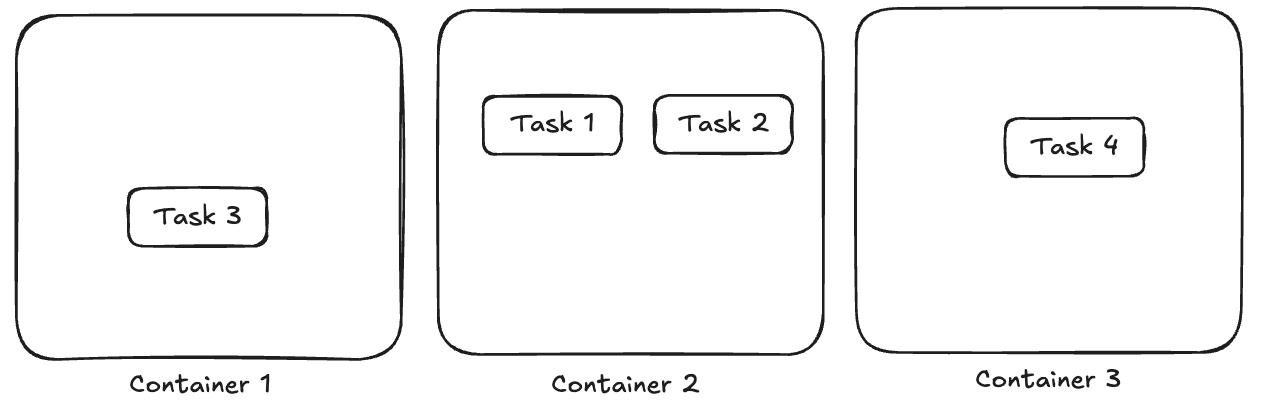
All examples share this setup: 4 tasks split into two groups (group0 =
task0, task1; group1 = task2, task3), placed across 3 hosts.
Partition:
Initial assignment: host0 holds task0, task1, task2; host1 holds
task3; host2 is empty. group0 prefers host1 and group1 prefers host2
(expressed with an AssignmentAffinities goal), so without any limit every task
would move toward its preferred host.
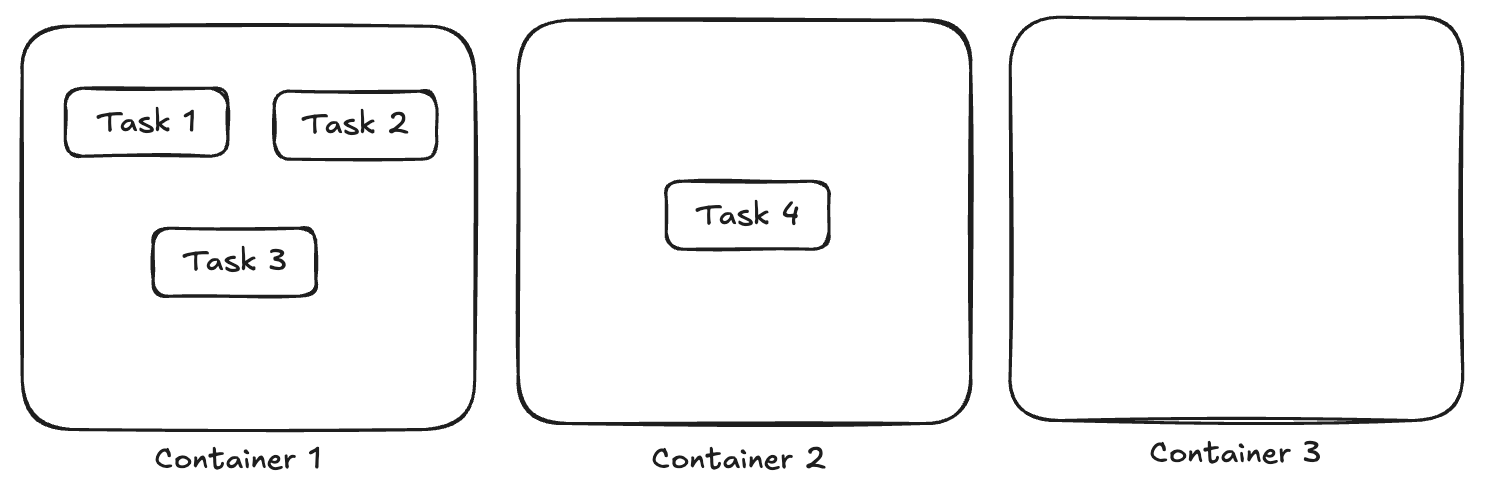
(The diagrams number tasks and containers from 1, so Task 1 = task0, Container 1
= host0, and so on.)
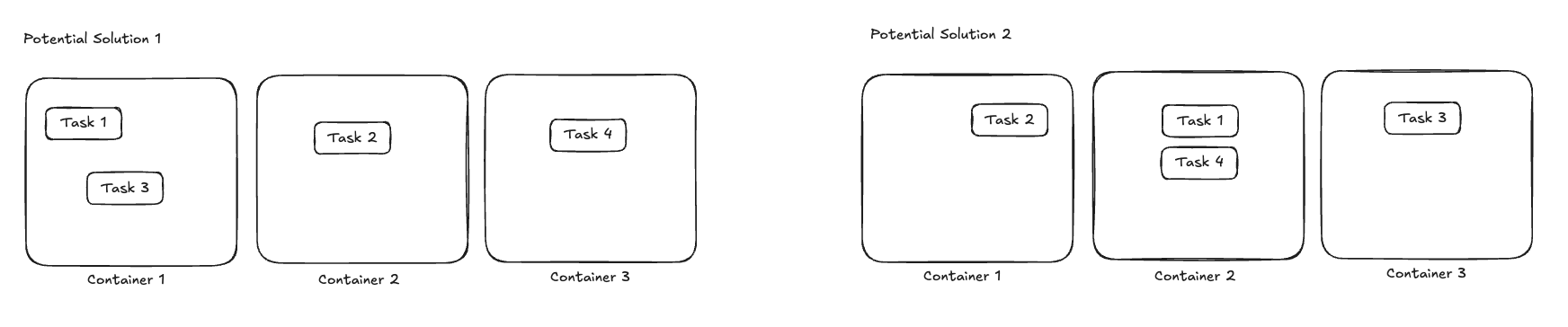
A GroupMoveLimit constraint with a global limit of 1 lets each group move at most one of its objects, so each group can satisfy only part of its preference:
solver.setObjectName("task");
solver.setContainerName("host");

solver.setAssignment(std::map<std::string, std::vector<std::string>>{
    {"host0", {"task0", "task1", "task2"}},
    {"host1", {"task3"}},
    {"host2", {}},
});

// Two groups of two tasks each.
solver.addPartition(
    "group",
    std::map<std::string, std::string>{
        {"task0", "group0"}, {"task1", "group0"},
        {"task2", "group1"}, {"task3", "group1"}});

// (group0 prefers host1 and group1 prefers host2 via an AssignmentAffinities goal.)

// Each group may move at most one of its objects.
GroupMoveLimitSpec groupMoveLimit;
groupMoveLimit.partitionName() = "group";

Limit limit;
limit.type() = LimitType::ABSOLUTE;
limit.globalLimit() = 1;
groupMoveLimit.limit() = limit;

solver.addConstraint(groupMoveLimit);
There are several valid solutions; each leaves each group having moved at most once:
Constraint only
GroupMoveLimit can only be used as a constraint; there is no goal form. Add it
with solver.addConstraint. As with any constraint, if the initial assignment
already satisfies it the final one will too, and if it is initially broken the
general constraint policy applies.
Limit
The limit (Limit) caps the number of moves per group; the
default is an absolute global limit of 1. Use groupLimits to set a different
cap per group---for example, allow group0 up to 2 moves while forbidding group1
from moving at all (Example 2). With a dimension, the limit bounds
the summed dimension of the moved objects rather than their count.
Which moves count
By default every move of a group's object counts toward that group's limit. The two filters narrow which moves are counted, by the move's source and destination scope items:
sourceScopeItemsAffectingLimitFilter--- a move counts only if it leaves a scope item selected by this filter.destinationScopeItemsAffectingLimitFilter--- a move counts only if it enters a scope item selected by this filter.
A move counts toward a group's limit only when both conditions hold. Moves that fall outside the filters are always allowed, regardless of the limit (Example 3).
More Examples
All examples build on the shared setup above. Each links to its runnable unit test.
Example 2: per-group limit
A GroupMoveLimit with groupLimits of 2 for group0 and 0 for group1: group0
may move freely toward its preferred host while group1 is pinned in place. Only
group0 ends up moving.
(source)
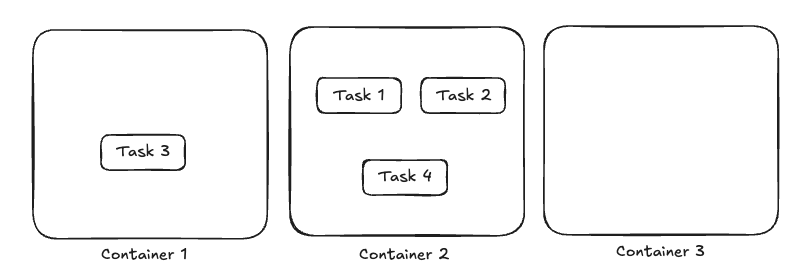
Example 3: filtering which moves count
A global limit of 0 (normally pinning everything in place), but with
sourceScopeItemsAffectingLimitFilter whitelisting {host0, host2} and
destinationScopeItemsAffectingLimitFilter blacklisting {host1}. group0 can
still move to host1 because moves into host1 do not count; and task3 can
move out of host1 because moves out of host1 (not in the source whitelist) do
not count either.
(source)
Source
- Thrift definition:
interface/thrift/ProblemSpecs.thrift(GroupMoveLimitSpec) - SpecBuilder:
materializer/spec_builder/GroupMoveLimitSpecBuilder.cpp---the code that defines this spec's behavior - Tests and runnable examples:
interface/tests/GroupMoveLimitSpecTest.cpp---the unit tests the snippets on this page are drawn from