Maximize Allocation
Type: Goal
Maximize the utilization of a set of scope items. The goal rewards filling scope
items as much as possible for a given dimension, which is useful when objects
contribute more on some scope items than others and you want to place them where
they pack best.
Parameters
| Parameter | Type | Required | Default | Description |
|---|---|---|---|---|
name | string | Yes | - | Descriptive name for logging/debugging |
scope | string | Yes | - | Scope whose scope items' utilization is maximized (e.g. "host") |
dimension | string | Yes | - | Dimension whose relative utilization is maximized |
filter | Filter | No | all scope items | Which scope items count toward the goal (set itemsWhitelist or itemsBlacklist) |
The goal value is proportional to the negated sum of each scope item's relative utilization for
dimension, so minimizing it maximizes the total fill across the selected scope
items.
Example
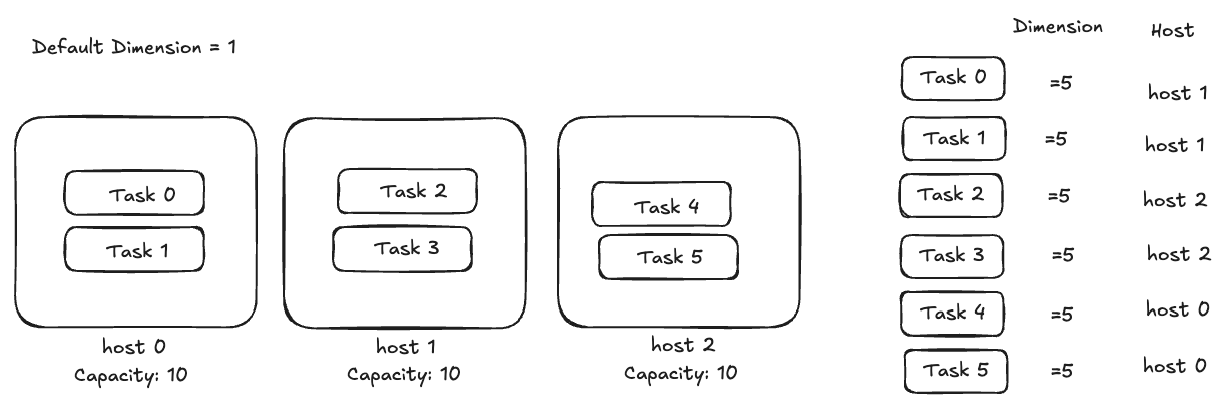
This example uses a dynamic dimension: each task contributes 1 by default, but
5 on its preferred host. There are 3 hosts (capacity 10 each) and 6 tasks.
Initially every task sits on a host where it contributes only 1, so each host is
at 2/10 = 20% utilization.
Initial assignment:
solver.setObjectName("task");
solver.setContainerName("host");

solver.setAssignment(std::map<std::string, std::vector<std::string>>{
    {"host0", {"task0", "task1"}},
    {"host1", {"task2", "task3"}},
    {"host2", {"task4", "task5"}},
});

// "load" is a dynamic dimension: each task contributes 1 by default, but 5 on its
// preferred host. Each host has a capacity of 10 for the same dimension.
solver.addDynamicObjectDimension(
    "load", "host",
    std::map<std::string, std::map<std::string, double>>{
        {"host1", {{"task0", 5}, {"task1", 5}}},
        {"host2", {{"task2", 5}, {"task3", 5}}},
        {"host0", {{"task4", 5}, {"task5", 5}}},
    },
    /*defaultValue=*/1);
solver.addScopeDimension(
    "load", "host",
    std::map<std::string, double>{{"host0", 10}, {"host1", 10}, {"host2", 10}});

// Maximize the hosts' utilization of "load".
MaximizeAllocationSpec maximizeAllocation;
maximizeAllocation.scope() = "host";
maximizeAllocation.dimension() = "load";
solver.addGoal(maximizeAllocation);
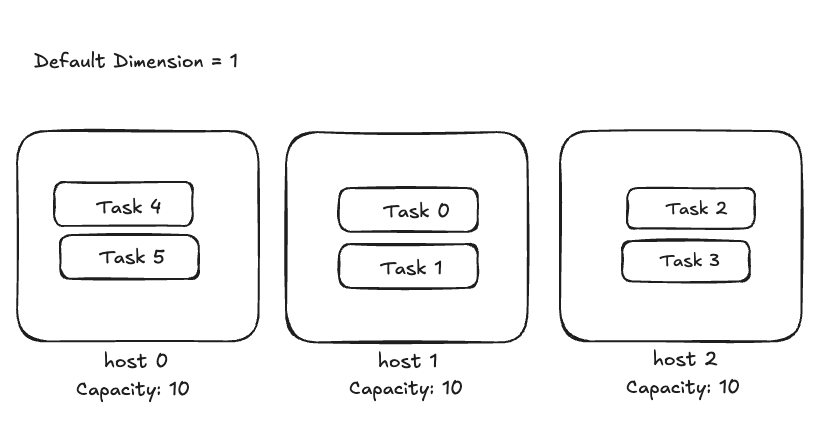
Rebalancer moves each task to its preferred host, where it contributes 5. Each
host then holds two such tasks for 10/10 = 100% utilization.
Final assignment:
Goal only
MaximizeAllocation can only be used as a goal; there is no constraint form. Its
value competes with other goals, so utilization is increased only when the gain
outweighs other costs. Use filter to maximize utilization on a subset of scope
items---for example, draining everything else onto a chosen set.
Source
- Thrift definition:
interface/thrift/ProblemSpecs.thrift(MaximizeAllocationSpec) - SpecBuilder:
materializer/spec_builder/MaximizeAllocationSpecBuilder.cpp---the code that defines this spec's behavior - Tests and runnable examples:
interface/tests/MaximizeAllocationTest.cpp---the unit test for this spec