Disaster Recovery Capacity
Type: Goal or Constraint
Reserve enough spare capacity to survive the failure of a failure domain. A disaster group is a set of scope items that fail together (e.g. all hosts in a rack, or a region). When such a group goes down, the load it was carrying fails over to surviving scope items via secondary (replica) objects. This spec sizes that failover: as a goal it minimizes the extra capacity that would be needed, and as a constraint it ensures every scope item can absorb the worst-case failover while staying within its capacity.
Parameters
| Parameter | Type | Required | Default | Description |
|---|---|---|---|---|
name | string | Yes | - | Descriptive name for logging/debugging |
scope | string | Yes | - | The scope where disasters happen; its scope items are the units that can fail |
dimension | string | Yes | - | The capacity dimension d, defined on objects (each object's load) and on scope items (each scope item's capacity) |
sharedDisasterGroups | list<set<string>> | No | each scope item alone | Each set lists scope items that fail together. Any scope item not in some set is treated as its own singleton disaster group |
primaryToSetOfSecondaryObjects | map<string, list<string>> | No | Maps each primary object to its ordered list of secondary (failover) objects, highest-priority first |
How it works
For each scope item, the spec computes a total required usage that combines normal load with the worst-case failover load:
- Primary usage --- the sum of
dimensionover the primary objects placed on the scope item in the final assignment. - Disaster usage --- for each disaster group (one failure scenario), the
excess load the scope item must absorb if that group fails; the spec takes
the maximum across all scenarios. When a group fails, a primary
Pwhose scope item is in the failing group sheds its load onto the highest-priority secondary ofPthat did not also fail: a secondaryRon scope itemScontributes its load toSonly whenPis in the failing group and every higher-priority secondary ofPis in the failing group too. Scope items that are themselves in the failing group contribute nothing (they are down).
total usage(scope item) = primary usage + max-over-scenarios disaster usage.
- As a constraint, each scope item must satisfy
total usage ≤ capacity, where capacity is the scope-item value ofdimension. So no scope item is overcommitted in any single failure scenario. - As a goal, the value is the total amount by which scope items exceed their capacity---i.e. the additional capacity that would have to be provisioned.
A consequence: placing a primary and its secondary on scope items that fail together makes the failover free (both die in the same disaster), so the solver is pushed toward such placements.
Example
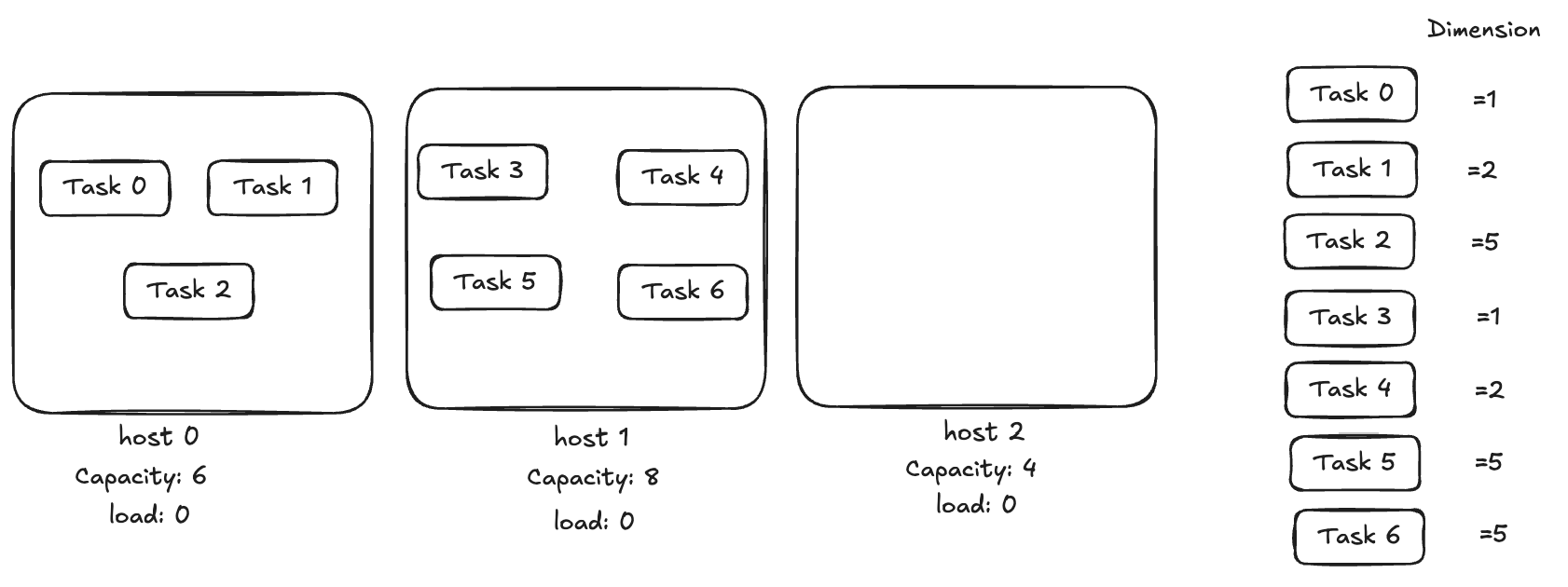
The examples share this setup: 3 hosts and 7 tasks. host0 holds task0-task2,
host1 holds task3-task6, and host2 is empty. Each task has a load. The
diagram also shows a per-host capacity of 6/8/4---a separate dimension that this
goal example does not use. The goal below uses the load dimension, whose per-host
capacity is left at 0:
There are three primary objects, each with one secondary (failover) replica:
task0→task3, task1→task4, task2→task5.
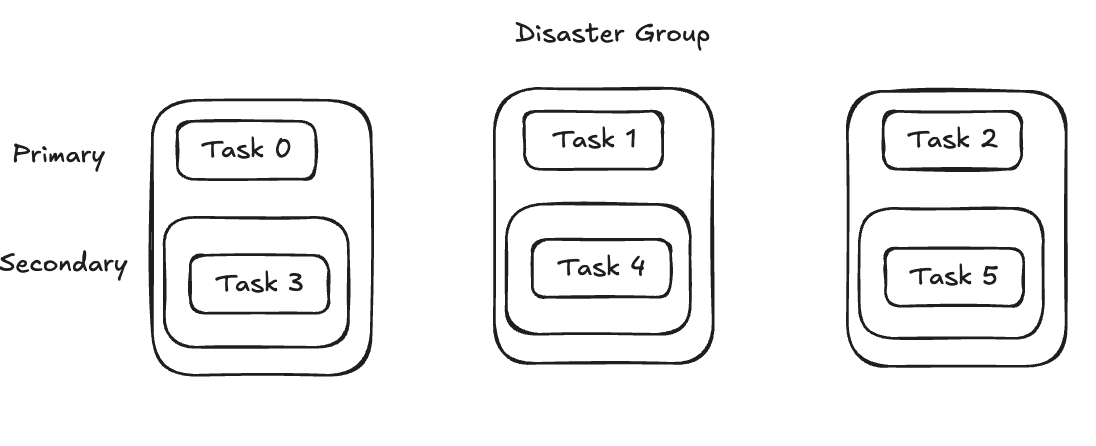
Each host is its own disaster group (the default). Used as a goal, the spec value is the total failover load that must be reserved. (source)
solver.setObjectName("task");
solver.setContainerName("host");

solver.setAssignment(std::map<std::string, std::vector<std::string>>{
    {"host0", {"task0", "task1", "task2"}},
    {"host1", {"task3", "task4", "task5", "task6"}},
    {"host2", {}},
});

// Each task's load. The hosts' "load" capacity is left at 0, which puts the spec
// in goal mode where the objective reports the raw reserved load. (For a
// constraint, set these to each host's real capacity instead.)
std::map<std::string, double> load = {
    {"task0", 1}, {"task1", 2}, {"task2", 5},
    {"task3", 1}, {"task4", 2}, {"task5", 5}, {"task6", 5}};
solver.addObjectDimension("load", load);
solver.addScopeDimension(
    "load", "host",
    std::unordered_map<std::string, double>{{"host0", 0}, {"host1", 0}, {"host2", 0}});

// task0, task1, task2 are primaries; each has one secondary failover replica.
DisasterRecoveryCapacitySpec drCapacity;
drCapacity.scope() = "host";
drCapacity.dimension() = "load";
drCapacity.primaryToSetOfSecondaryObjects() = {
    {"task0", {"task3"}},
    {"task1", {"task4"}},
    {"task2", {"task5"}},
};
solver.addGoal(drCapacity);
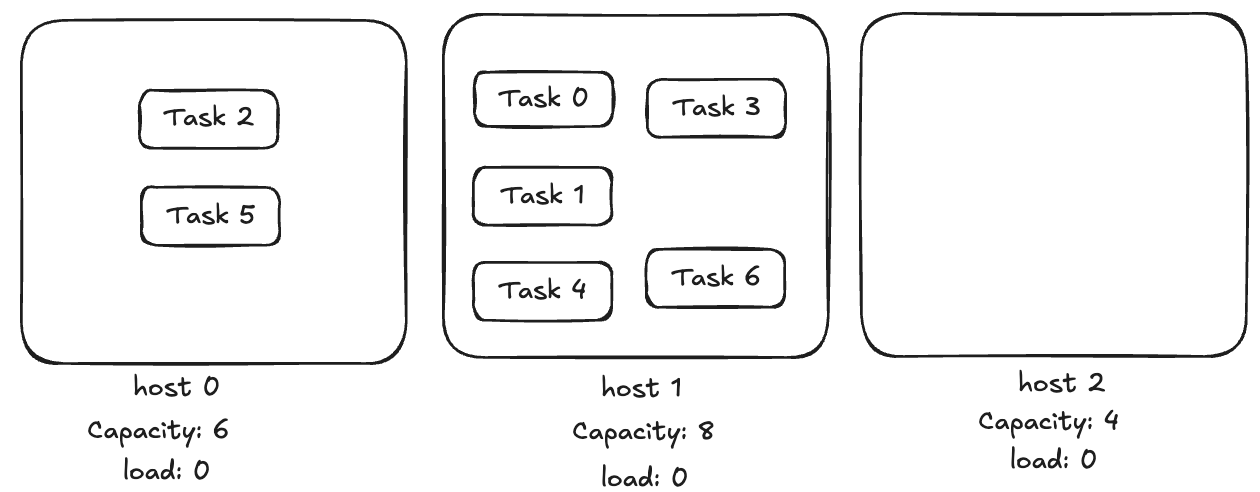
Because nothing forces primaries and secondaries apart, the solver colocates each
primary with its secondary, so when a host fails both copies die together and no
failover capacity is needed elsewhere. Only the primary load remains, giving an
objective of task0 + task1 + task2 = 1 + 2 + 5 = 8:
Goal vs. constraint
As a constraint, set each scope item's value of dimension to its real
capacity; the spec then guarantees that, for every single failure scenario, the
surviving scope items can absorb the failover without exceeding capacity. If the
initial assignment already satisfies this, so will the final one; otherwise the
general constraint policy applies.
As a goal, the value is the aggregate capacity shortfall across scope items (the extra capacity to provision); minimizing it drives load and its failover replicas into arrangements that need the least disaster reservation.
More Examples
Both examples build on the setup above.
Example 2: secondary forced onto a surviving scope item
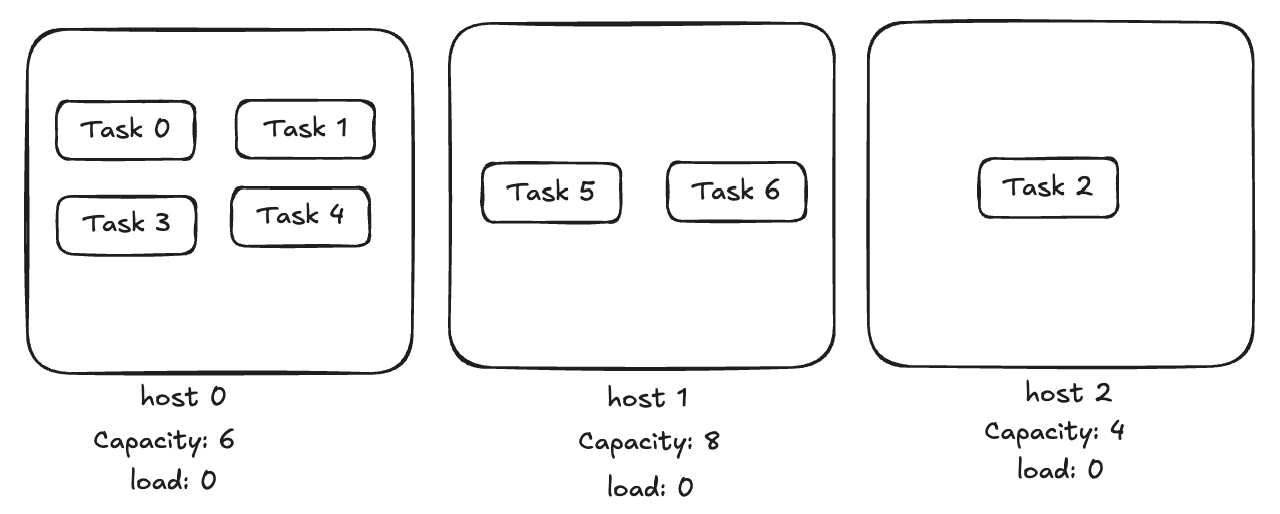
Same as the example above, but an ExclusiveObjects constraint forbids
task2 and its secondary task5 from sharing a host. Now, if the host holding task2 fails, task5 (on a
different, surviving host) must take over task2's load---so that host has to
reserve an extra 5. The objective becomes primary load 8 plus the failover load
5, for a total of 13.
(source)
The example above (each primary colocated with its secondary) is the
OnlyPrimaryObjectsMatter
test.
Source
- Thrift definition:
interface/thrift/ProblemSpecs.thrift(DisasterRecoveryCapacitySpec) - SpecBuilder:
materializer/spec_builder/DisasterRecoveryCapacitySpecBuilder.cpp---the code that defines this spec's behavior - Tests and runnable examples:
interface/tests/DisasterRecoveryCapacitySpecTest.cpp---the unit tests the snippets on this page are drawn from