Minimize Movement
Type: Goal or Constraint
Minimize, or hard-limit, how many objects move between scope items. For example, discourage churn so Rebalancer only relocates objects when the gain is worth it, or cap the number of moves a single rebalance may perform.
Parameters
| Parameter | Type | Required | Default | Description |
|---|---|---|---|---|
name | string | Yes | - | Descriptive name for logging/debugging |
scope | string | Yes | - | Scope across whose scope items movement is counted (e.g. "host") |
dimension | string | Yes | - | What a move costs; commonly the implicit {object}_count dimension, so cost is the number of moves |
magicScaling | bool | No | true | When normalizing, multiply the result by 0.001 (ignored when doNotNormalize is true) (see Normalization) |
doNotNormalize | bool | No | false | Use the raw, un-normalized cost (the recommended setting); see Normalization |
allowance | double | No | 0 | Amount of movement (in dimension) that is free / allowed before any cost or limit applies (see Allowance) |
Example
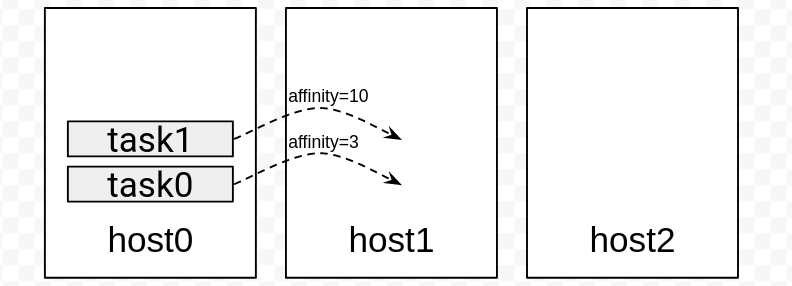
An example use: only move objects when the benefit outweighs the cost. There are 3
hosts and 2 tasks, both initially on host0. Both prefer host1 (an
AssignmentAffinities goal): task0 with affinity 3, task1 with affinity 10. A
MinimizeMovement goal makes each move cost 4.
(source)
Initial assignment:
solver.setObjectName("task");
solver.setContainerName("host");

solver.setAssignment(std::map<std::string, std::vector<std::string>>{
    {"host0", {"task0", "task1"}},
    {"host1", {}},
    {"host2", {}},
});

// Both tasks prefer host1: task0 with affinity 3, task1 with affinity 10.
auto pref = [](std::string task, std::string host, double affinity) {
  AssignmentAffinity entry;
  entry.objectName() = std::move(task);
  entry.scopeItemName() = std::move(host);
  entry.affinity() = affinity;
  return entry;
};

AssignmentAffinitiesSpec affinities;
affinities.scope() = "host";
affinities.affinities() = {
    pref("task0", "host1", 3),
    pref("task1", "host1", 10),
};
solver.addGoal(affinities);

// Each move costs 4 (the goal's weight); count moves with the task_count
// dimension, without normalization.
MinimizeMovementSpec minimizeMovement;
minimizeMovement.scope() = "host";
minimizeMovement.dimension() = "task_count";
minimizeMovement.doNotNormalize() = true;
solver.addGoal(minimizeMovement, 4);
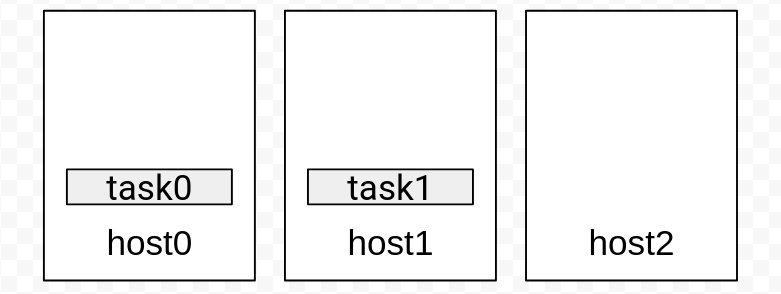
task1 moves to host1 because its affinity gain (10) outweighs the move cost
(4), while task0 stays put because its gain (3) is less than the cost (4).
Final assignment:
Goal vs. constraint
As a goal, each unit of movement beyond the allowance adds cost, which
competes with the gains from other goals. Rebalancer performs a move only when it
has a net positive effect---so a move happens only if its benefit elsewhere offsets
its movement cost.
As a constraint, it becomes a hard cap: Rebalancer may perform at most
allowance worth of movement on top of the initial assignment. Set allowance to
the number of moves (or amount of dimension) you want to permit.
The local search solver is greedy and only applies moves that strictly improve the objective, so it already avoids needless moves even without this spec. The optimal (MIP) solver, however, may freely reshuffle objects among equally-optimal solutions; add a MinimizeMovement goal (even with a tiny weight) to make it prefer the solution that moves the least.
Allowance
allowance is an amount of free movement, expressed in the spec's dimension.
As a goal, moves within the allowance incur no cost; only movement beyond it is
penalized. As a constraint, the allowance is the limit---the maximum amount of
movement permitted (Example 5).
Normalization
Normalization only affects the numeric value of the goal:
- Non-normalized (
doNotNormalize = true, the recommended setting): the value equals the number of objects moved (or the summeddimensionof the moved objects).magicScalingis ignored. Scale it with the goal's weight. - Normalized (the current default): the same value, but divided by the number
of scope items, and---if
magicScalingis on---multiplied by0.001.
When the dimension is also defined on the scope items, the normalized cost of a
move additionally depends on the destination scope item's capacity: moving into
a larger-capacity scope item is cheaper. The full normalized formula is:
(magicScaling ? 0.001 : 1)
  * sum(objectDimension[move.object] / scopeItemDimension[move.destination] for move in moves)
  / scopeItemCount
Example 2 is Example 1 with normalization enabled (and asserts the resulting values).
More Examples
All examples build on a similar setup to the example above. Each links to its runnable unit test.
Example 2: same cost per object, with normalization
Example 1 with normalization enabled. The per-move costs change, and both tasks turn out worth moving to their preferred host. The unit test asserts the exact values and explains how they are computed. (source)
Example 3: different cost per object, without normalization
Like Example 1, but each object has its own move cost, modeled with a dimension
that describes how costly each object is to move.
(source)
Example 4: cost proportional to capacity, with normalization
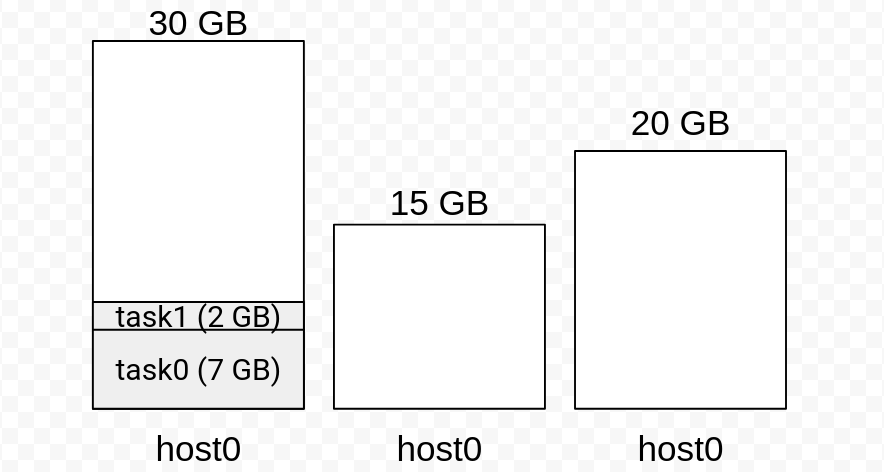
Tasks have a cost proportional to their size (in GB), with normalization enabled,
so the cost of a move is inversely proportional to the destination scope item's
capacity. There are 3 hosts and 2 tasks, plus a constraint forcing host0 to
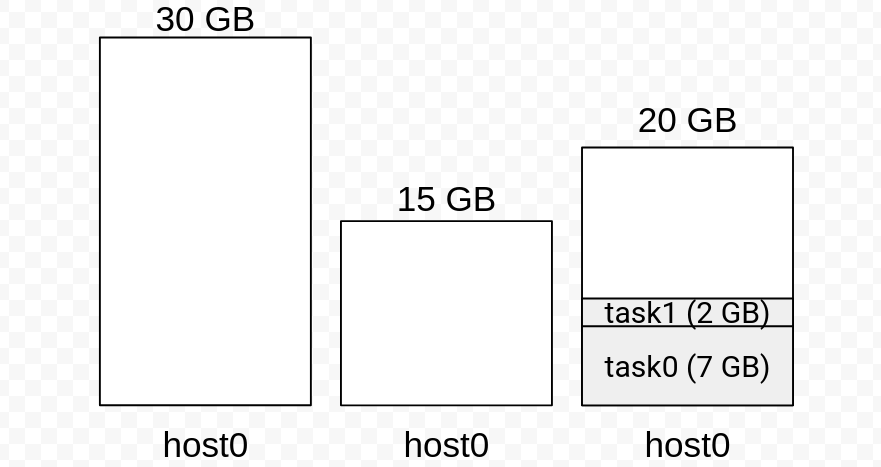
empty. Rebalancer must move both tasks off host0, and picks host2 over host1
because host2's larger capacity means a smaller relative-utilization increase
(45% on host2 vs. 60% on host1).
(source)
Initial assignment:
Final assignment:
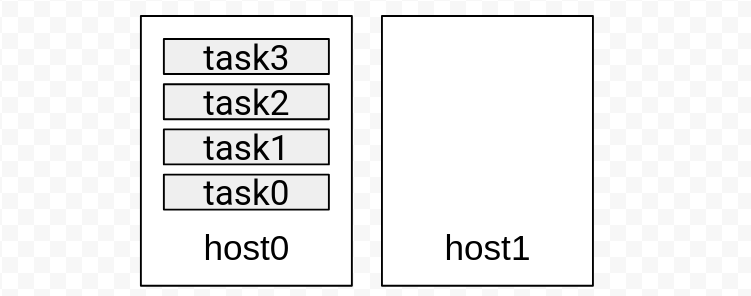
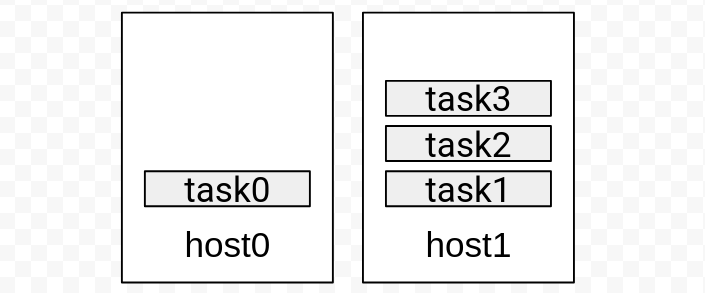
Example 5: allowance as a hard limit
Used as a constraint rather than a goal. host0 starts with 4 tasks and
host1 is empty; all tasks prefer host1 equally. A MinimizeMovement constraint
with an allowance of 3 caps the number of moves at 3. Rebalancer moves exactly 3
tasks---moving a fourth would improve the affinities goal further but would break
the constraint.
(source)
Initial assignment:
Final assignment:
Source
- Thrift definition:
interface/thrift/ProblemSpecs.thrift(MinimizeMovementSpec) - SpecBuilder:
materializer/spec_builder/MinimizeMovementSpecBuilder.cpp---the code that defines this spec's behavior - Tests and runnable examples:
interface/tests/MinimizeMovementTest.cpp---the unit tests the snippets on this page are drawn from