Single Coldest Stratified
Evaluates moving an object to a sample of the coldest containers---those with the lowest "potential", where potential reflects a container's contribution to the goal values and how many objects it holds---drawn from similarity classes. It is like Single Random Stratified, but picks the coldest containers in each class instead of a random sample.
Unlike the other move types, Single Coldest Stratified has no dedicated move type spec
yet. It is selected by name via ProblemSolver::makeMoveTypeSpec("SINGLE_COLDEST_STRATIFIED"),
and its options are set as fields on the LocalSearchSolverSpec.
Parameters
These are fields on the LocalSearchSolverSpec (not a move type spec):
| Parameter | Type | Required | Default | Description |
|---|---|---|---|---|
stratifiedSampleSize | int | No | - | Number of coldest containers sampled (per similarity class) |
includeEqualSizeRandomSampleForSingleColdestMoveType | bool | No | false | Also try an equal-size random sample of containers as candidate destinations (doubling the sample) |
The similarity classes are provided separately via ProblemSolver::addSimilarContainers.
Behavior
For the object being moved, the coldest containers within each similarity class are chosen as candidate destinations (optionally alongside a random sample), and the best resulting move is applied. This tends to fill the emptiest containers first.
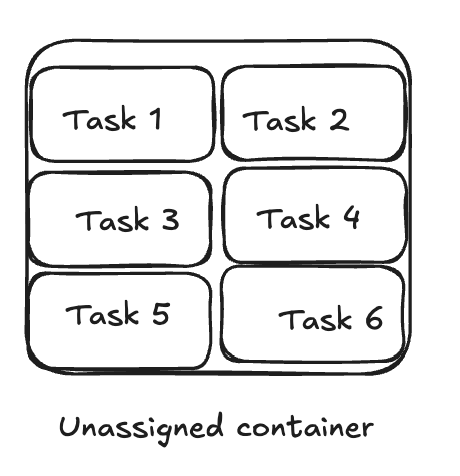
Draining that container distributes its tasks to the coldest containers:


Example
Configure local search to use only the single coldest stratified move type, sampling the single coldest container per class:
LocalSearchSolverSpec localSearch;
localSearch.moveTypeList()->push_back(
    ProblemSolver::makeMoveTypeSpec("SINGLE_COLDEST_STRATIFIED"));
localSearch.stratifiedSampleSize() = 1;

solver.addSolver(localSearch);

// Declare which containers are similar to each other.
solver.addSimilarContainers({{"host0", "host1", "host2", "host3"}});
(source)