Single Chain
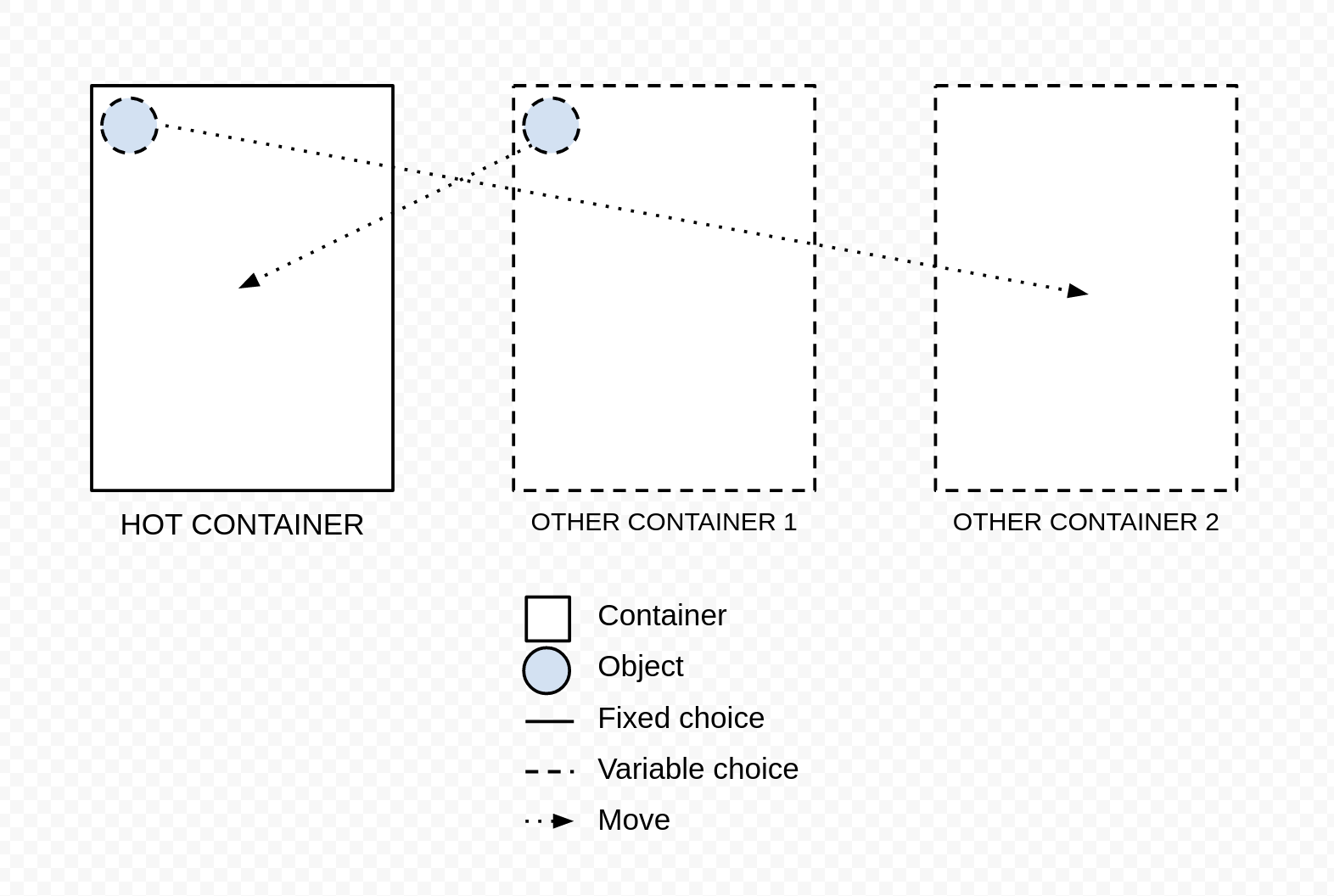
Evaluates two-object chains: one object leaves the hot container for another container, and a second object takes its place in the hot container. Here the hot container sits in the middle of the chain---it gives out one object and receives one back.
tip
Single End Chain is usually the better default. It produces the same kind of two-object chain, but leaves the hot container at the end (it gives out an object without receiving one back).
Parameters
| Parameter | Type | Required | Default | Description |
|---|---|---|---|---|
partitionNameToExploreChainsWithinObjectGroup | string | No | - | If set, only objects in this partition are considered as the object that takes the hot object's place |
specialColdContainer | string | No | - | If set, a fixed destination container for the hot object; otherwise all containers are explored |
Behavior
Given the hot container chosen by the common logic:
- Pick one object from the hot container (the "hot object").
- Pick two other containers, "other container 1" and "other container 2".
- Pick one object from "other container 1" (the "other object").
- Evaluate, at once, moving the hot object to "other container 2" and the other object into the hot container.
Every such combination is evaluated and the best chain is selected.
Complexity
Roughly (objects ^ 2) * containers neighbors are evaluated.
Example
Configure local search to use only the single chain move type:
LocalSearchSolverSpec localSearch;
localSearch.moveTypeList()->push_back(
    ProblemSolver::makeMoveTypeSpec(SingleChainMoveTypeSpec()));

solver.addSolver(localSearch);
(source)