Colocate Groups
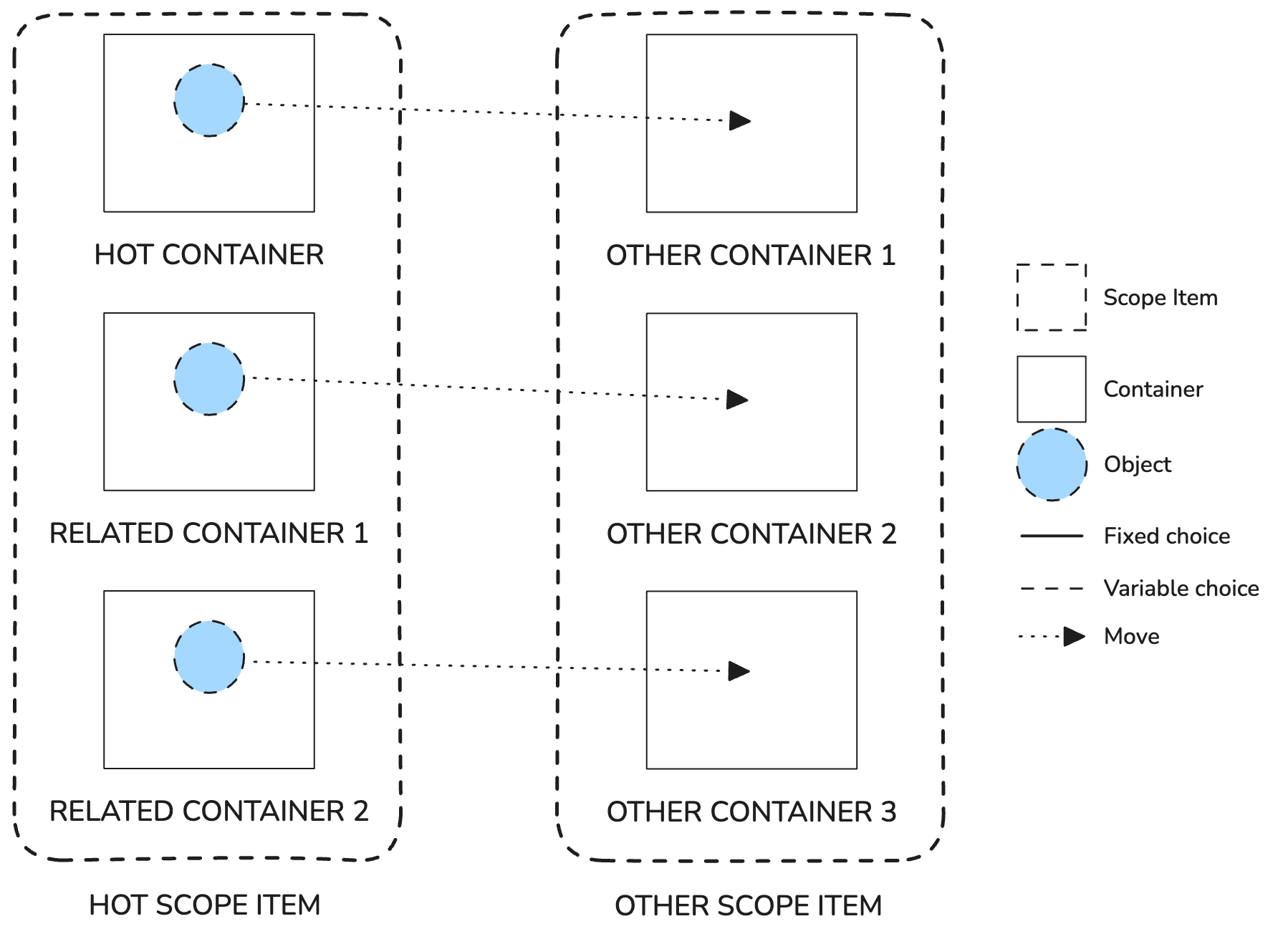
Tries moving a related set of objects that share a scope item to every possible combination of containers in each of the other scope items, so that related groups end up colocated within the same scope. Useful when several groups (e.g. the shards of a replica set) must live together in the same region or fault domain.
Parameters
| Parameter | Type | Required | Default | Description |
|---|---|---|---|---|
partitionName | string | Yes | - | The partition whose groups are colocated |
relatedGroupsList | list<ColocateGroupsMoveTypeRelatedGroupsInfo> | Yes | - | Sets of related groups; each set is colocated together, and the sets must be disjoint |
colocationScopeName | string | Yes | - | The scope within which each set of related groups must be colocated (e.g. region) |
colocationScopeItemToGroupToContainers | map | No | all containers | Per scope item and group, restricts the candidate containers considered |
defaultSampleSize | int | No | all destinations | Samples the candidate containers for each (group, scope item) |
Behavior
For each set of related groups, the move type evaluates relocating the group's objects from their current scope item into the containers of every other scope item, trying the possible container combinations (optionally sampled). The best combination that improves the objective---bringing the related groups into the same scope---is applied.
Complexity
Roughly n * |S| * |G|^k, where n is the number of objects moved, |S| the number
of scope items, |G| the candidate containers per group, and k the number of groups
colocated together.
Example
Configure local search to use only the colocate groups move type:
ColocateGroupsMoveTypeSpec colocateGroups;
colocateGroups.partitionName() = "replica_set";
colocateGroups.colocationScopeName() = "region";
// relatedGroupsList describes which groups must be colocated together.

LocalSearchSolverSpec localSearch;
localSearch.moveTypeList()->push_back(
    ProblemSolver::makeMoveTypeSpec(colocateGroups));

solver.addSolver(localSearch);
(source)